
News
How many police homicides in the US? A reconsideration
(This post is co-authored by Patrick Ball and Kristian Lum.)
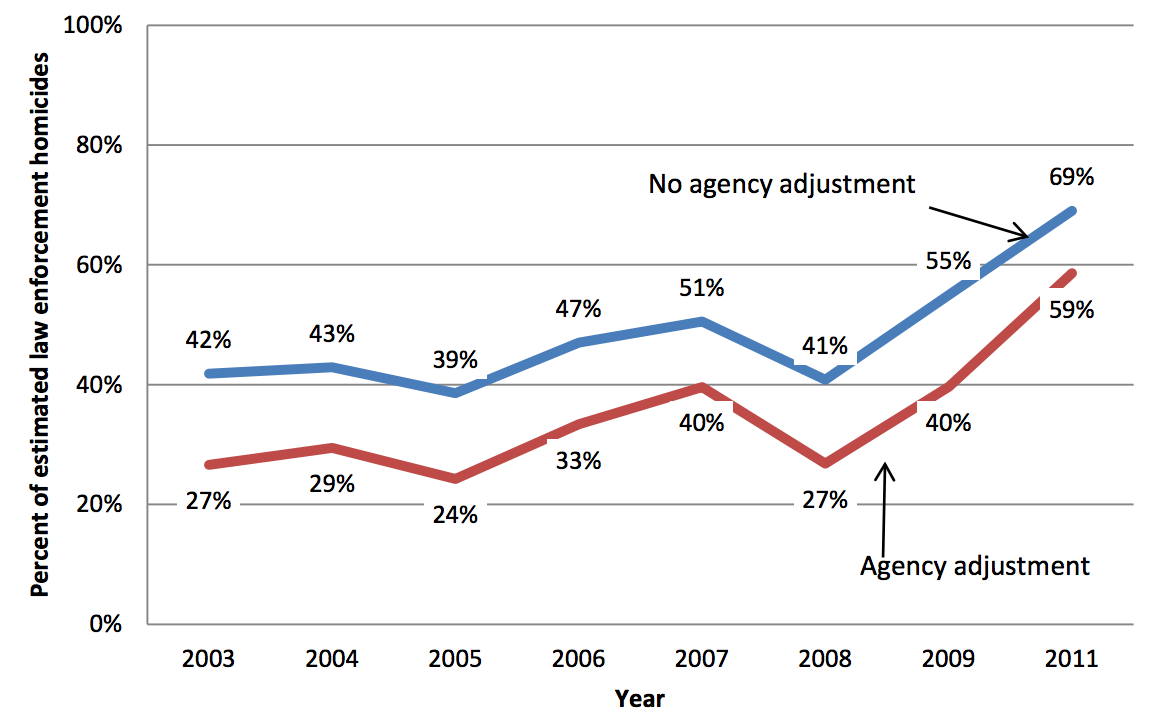
In early March, the Bureau of Justice Statistics published a report that estimated that in the period 2003-2009 and 2011, there were approximately 7427 homicides committed by police in the US. We responded that the method the analysts used, capture-recapture with two databases, is vulnerable to underestimation if the databases exhibit positive dependence. We conduct a thorough sensitivity analysis on the original independence model as applied to the police homicides databases. We used information from several ...
HRDAG Retreat 2015
I look at the beach and then at the table surrounded by nerds, deep in thought and conversation about Dirichlet priors, matching algorithms, and armed conflicts. This peculiar (in the best way) environment catalyzes a moment of reflection: how did I get here?
Four years ago, as a second-year statistics PhD student, I watched "Guatemala: The Secret Files" on PBS Frontline World. I listened to stories of family members who disappeared without answers or justice. Then the story shifted to the work being done by archivists and data experts at Guatemala's Historic Archive ...

BJS Report on Arrest-Related Deaths: True Number Likely Much Greater
(This post is co-authored by Patrick Ball and Kristian Lum.)
Today the Bureau of Justice Statistics (BJS) released a report on their effort to document “all deaths that occur during the process of arrest in the United States.” The analysis estimates that the Arrest-Related Deaths (ARD) program covers only 34-49% of these deaths. A parallel program by the FBI (the Supplementary Homicide Reports, SHR) is estimated to cover approximately the same proportion of deaths. Even taking into consideration both programs, 28% of all police homicides remain unreported.
In ...
The Great Lessons in Research at the Archive
Doing an investigation on the contents of the Archive brought with it three major lessons. The first big lesson was the constant movement (nothing was static), The second great lesson was that everything evolved (the changes were a constant). The third major lesson was to discover how two institutions can work together while geographically far apart.
The constant movement
As there were other processes being carried out at the Archive, everything was in constant movement. In other words, one day the documents were in X location and tomorrow they may be in location Y ...

Evaluation of the Kosovo Memory Book
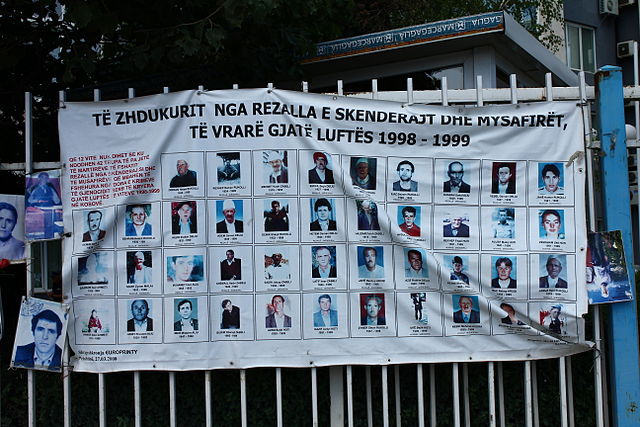
At the end of 2014 we completed the evaluation of the Kosovo Memory Book database and are pleased to conclude that the database has succeeded in documenting all or nearly all the human losses during conflicts in Kosovo during the period from 1998 to 2000.
With a motto of "Let people remember people," the goal of the Kosovo Memory Book (KMB) is to document all people who were killed or disappeared in connection with the war in Kosovo. The project aimed to document all human losses during armed conflict in the territory of the Former Yugoslav Republic (FYR) between 1998 ...
Guatemala’s Bol de la Cruz Found Guilty
Today Guatemala’s former national police chief Colonel Héctor Rafael Bol de la Cruz was convicted and sentenced to 40 years in prison for his role in the 1984 kidnapping and disappearance of 27-year-old student union leader Fernando Garcia, who was last seen when officers detained him outside his home. Along with Bol de la Cruz, former senior police officer Jorge Gomez was also tried; he received a sentence of 40 years in prison. That verdict comes in part because of testimony this month by HRDAG’s Patrick Ball, who served as an expert witness and presented data ...

Film: Solving for X
Solving for X documents Patrick's team as they travel to Guatemala, Kosovo, and Liberia, helping human rights supporters apply sophisticated computer analysis to human rights events.
