The Technology Freedom Cooperative Offers Civil Society New Independence from Big Tech
 In February 2025, the Trump Administration issued sanctions against the International Criminal Court for its investigations into potential war crimes and humanitarian violations by Israel in Gaza. A few months later, the AP and other news agencies reported that Microsoft had closed the account of the ICC’s chief prosecutor, denying him access to his emails. (Microsoft disputes this report.)
That moment epitomized a massive threat facing the human rights movement today: that the technical tools we rely on to do our work could be taken away from us—through corporate decisions, government pressure, or both.
As data scientists, we work with terabytes of data, including photographic evidence of war crimes, victims statements from citizen human rights projects, truth commissions, religious organizations, millions of pages of public records information, and more. These data become the foundation of our analyses and contributions to future accountability efforts. We use this information to create accurate histories of violence, and this evidence has been critical to the successful criminal prosecutions of dictators who violated human rights in the past.
But experience has shown us that we cannot rely on corporations like Microsoft, Google, Amazon Web Services, Dropbox or others to stand up against government pressure, especially on sensitive issues like contested international human rights investigations.
Therefore, the Human Rights Data Analysis Group (HRDAG) and our partners are announcing a new initiative to establish resilience against these types of attacks: the Technology Freedom Cooperative (TFC).
Along with our partners Invisible Institute, Innocence & Justice Louisiana, Data Cívica, and Kilómetro Cero, we are building shared technology infrastructure: distributed storage and computing capacity to preserve, process, and analyze critical human rights files.
Why does this matter? One of HRDAG’s guiding principles is “don’t lose the data.” We speak often of the importance of data preservation, and it comes down to the idea that human rights investigators need to ensure that there are always multiple, redundant copies of all the data they are using, ideally in multiple locations, and that we can prove that the copies have not been damaged or altered.
The Technology Freedom Cooperative is doing exactly that: backing up data in multiple physical locations (and legal jurisdictions) including Canada, the United States, Puerto Rico, Mexico, and Europe. That way, if one state becomes hostile to our work, we’ll still have full backups in other locations available for researchers to continue to do the work.
Preserving the data
Within this idea of data preservation are a few embedded and related ideas that are key to the design of our Technology Freedom Cooperative:
- Verifiable authentication: we use file hashes, digital signatures, and externally-verifiable time stamps (by placing our hashes in the Bitcoin blockchain) to prove that the data have not been corrupted, that only we could have uploaded the data, and that the data was preserved at or before the timestamp. This supports a record of provenance – which can be essential for using data in legal proceedings.
- Redundant accessibility: members of the cooperative need to have redundant, decentralized access to the data. This ensures that private companies or governments can’t deny us access to our own files, and that the work will continue even if something were to happen to any of our servers (for example, because they failed, were destroyed, or were seized by government agents).
- Trusted Partners: we built this project with deep trust having worked closely with all of the organizations involved for many years. Our collective is intentionally small because these systems work best with high trust across partners. We’re talking about it publicly — not to add more members to our cooperative — but to inspire other nonprofits working with sensitive data to replicate our model with their own trusted collaborators.
Jee Park, Executive Director of Truth & Justice Louisiana said: “This effort is not just a tech solution. IJLA’s involvement in TFC signals our commitment to preserving the data and evidence that communities everywhere need to seek justice, expose hidden truths, and bring transparency and accountability to the institutions that govern our lives.”
Expanding resources
There’s another key piece of the Technology Freedom Cooperative that goes beyond data storage. We are also building the technical capacity for our organizations to use artificial intelligence in ways that suit the unique needs of human rights researchers.
Organizations like HRDAG often deal with vast data sources—like with the CLEAN database, which includes millions of pages of PDFs received through public records requests that detail policy violations and violence by police officers in California. Using AI, we’re able to make sense of these files: for example, pulling out dates, names, locations, and categories (like “canine” or “sexual assault” or “spit hood”) that can help our investigators analyze datasets in ways that would have been impossible (or take years of manual work) before the advent of AI.
As statisticians, we need to ensure these tools are finding the true values in the data, and not inserting hallucinations or telling meaningless stories. Because of that, HRDAG and our partners:
- Cross-validate AI findings with human verification—we push our models toward a high degree of verifiability and then we publish our statistical measures of the verification, including its limits. So, for example, we might hand-check a few hundred randomly sampled records, then compare the human results to the AI’s results. We then use statistical models to estimate the AI’s overall consistency with human decisions; this is technically the AI’s reliability. Measuring reliability is an essential step for using AI, or any machine-guided decision, for data analysis, but often overlooked.
- Use human analysis of the findings to assess the accuracy of Large Language Model (LLM) outputs across four heuristics:
- Completeness (recall): Does the model include all the relevant results?
- Relevance (precision): Does it avoid including irrelevant material?
- Fidelity: Does it refrain from introducing information that wasn’t in the source data?
- Interpretation (validity): Does it correctly classify and summarize the material it analyzes?
These techniques are important for evaluating the performance of AI tools, but they do not address the risk posed by depending on access to commercial AI providers, access that could be revoked by changes in corporate policy, government pressure, or simply by rapid price increases. The Technology Freedom Cooperative is helping solve that problem by providing self-hosted compute for members. We use only open weights models, that is, models that are free to download and use on our own machines. This means that HRDAG and our partners choose which AI models to run, so that we can analyze data with a model that we can run as much as we like, we can reuse when we have to repeat analysis, and that cannot be taken away from us.Of course, hosting our own LLMs to do this work is computationally and financially expensive, and it takes a lot of staff time to organize and maintain the servers and compute. But it’s worth it to have systems that are controlled by HRDAG and our partners, with all the transcripts of AI sessions held privately, and with our usage free from license revocation or denial of service from big companies.
Building capacity within civil society
The Technology Freedom Cooperative isn’t just about physical infrastructure for data driven nonprofits. We’re also teaching a generation of researchers within these nonprofits how to manage the servers and steward their data.
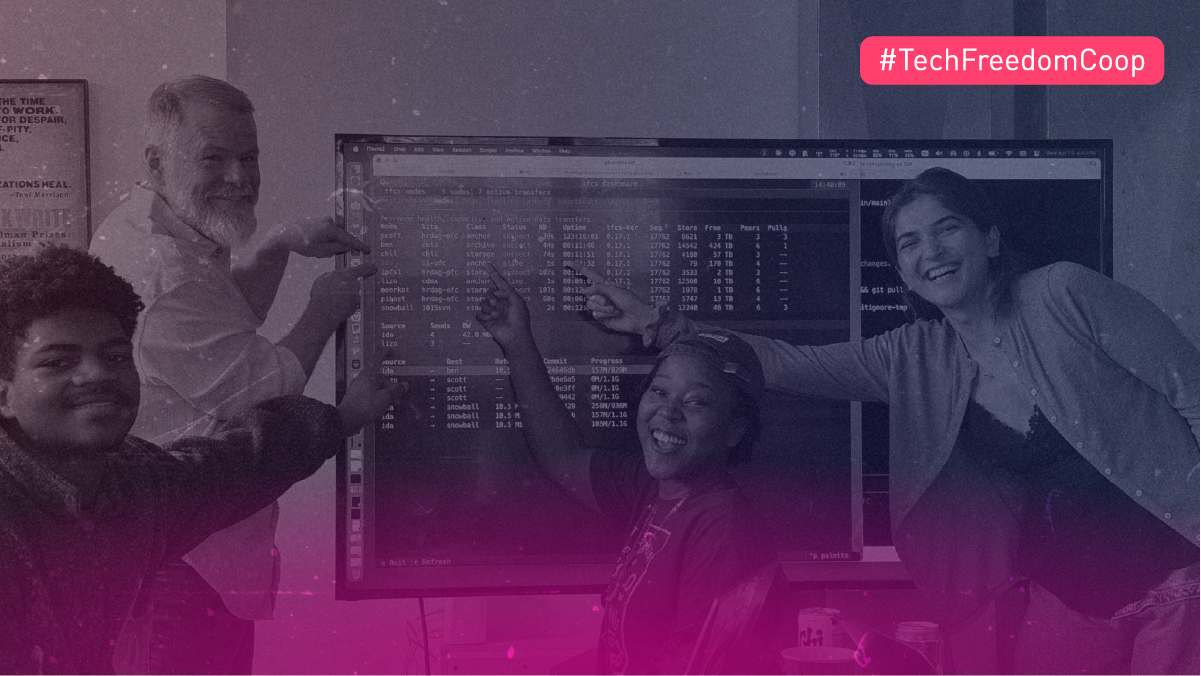
This means that HRDAG and our partners sourced and bought computer hardware, set it up, installed the operating system (we use debian linux), configured the security, built the software, and worked collaboratively to ensure the systems worked well. We built the tools to monitor the systems for security vulnerabilities, issues, or downtime, and we are teaching our partners how to modify and maintain the systems on their own. We are collectively owning the resilience of this system, and building capacity to maintain it for future generations of researchers and advocates.
“This collaboration is unique and inspiring for us as journalists,” said Maheen Khan, director of technology at the Invisible Institute. “We believe this decentralized system can be a model and a resource for other journalists in Chicago and beyond, as we collectively build a future where we protect information and work with more freedom and autonomy.”
The reason we are able to do this at all is thanks to the strong support of our funders, specifically the John D. and Catherine T. MacArthur Foundation. Their support covered the costs of substantial computer hardware for this project and partially offset the costs of the staff time involved.
Owning the tools of our work
HRDAG is a small nonprofit. For thirty-five years we’ve been using cutting-edge technology and rigorous statistical methods to challenge state-sponsored lies and establish the truth in the United States and around the world. We have always done this work in close partnership with the people and organizations gathering evidence on the ground. The Technology Freedom Cooperative extends that same collaborative model to the infrastructure on which our work depends. Together, we are building systems that can withstand political pressure, corporate interference, and changing legal conditions so that vital evidence remains secure, accessible, and useful for generations to come.
Technology should not be a point of vulnerability for civil society. In the hands of trusted partners, it can be resilient and support efforts toward justice.
Honoring our heroes with server names
One of the most fun parts of the project is naming all the hardware, because the different machines are referenced often in code and documents. Our network is composed of an archive server; a server used for compute; anchor servers for each partner; and several storage servers.
- Our archive server is called ben, for Ben Ferencz, an investigator and later prosecutor of war crimes during the Holocaust.
- Our compute server is kj for Katherine Johnson, a mathematician who was key to the early spaceflights at NASA.
- We named the machine that manages many administrative tasks sugihara for Chiune Sugihara, a Japanese diplomat who helped thousands of Jews flee the Holocaust by issuing visas.
- HRDAG’s anchor server is named herb, after Herb Spirer, who was a wonderful mentor. herb succeeds eleanor (named for Eleanor Roosevelt) and scott (named in honor of Scott Weikart).
- The Invisible Institute named their server ida, for Ida B. Wells, a key figure in the civil rights movement who co-founded the NAACP and worked for justice.
- Kilómetro Cero’s server is named ant, in honor of Antonia Martínez Lagares, whose death by police in Puerto Rico became a lasting symbol of police violence and political repression.
- Innocence & Justice Louisiana’s server is named dwight, in honor of Dwight Labran, the first person that the Innocence Project was able to exonerate, in 2001.
Help Keep The Technology Freedom Cooperative Online
- Believe in HRDAG and this project? Please donate today or email meganp@hrdag.org to talk about a major gift to support this initiative.
- Want to set up your own cooperative with your own trusted partners? Email pball@hrdag.org and we are happy to answer questions about the hardware we chose and the system we built.