Building the Technology Freedom Cooperative
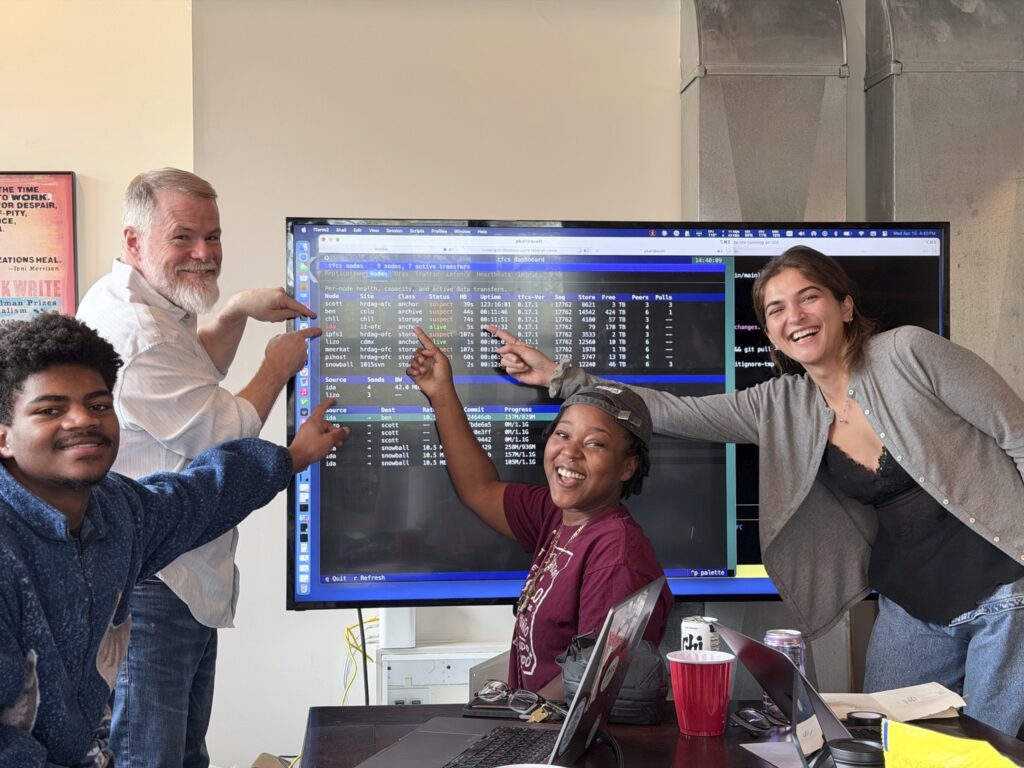
Image of the installation at Invisible Institute, Chicago, including: Afam Anigbo, Patrick Ball, trina reynolds-tyler, and Maheen Khan.
Structural Zero 13
I arrived at the Invisible Institute on a sunny morning in April. The organization is housed at the Experimental Station, just south of the University of Chicago—an old brick building that is home to several nonprofit projects.
I was excited to launch this new project, and I saw that excitement mirrored in the faces of colleagues I had known for years as well as people I was meeting for the first time. Our carefully packed cardboard boxes were filled with electronic equipment, computers, and servers—everything I would need to install the first hub of the Technology Freedom Cooperative.
This was my first official installation, but by then the hardware was already familiar. Back in February, I had set up one of the new servers and its accessories in my office in San Francisco. I spent three months writing software, combining free software tools, testing, debugging, re-testing, and then re-testing yet again a system designed to safeguard sensitive data.
One of our guiding principles at HRDAG is “Don’t lose the data.” Human rights investigators and researchers need to ensure that there are always multiple, redundant copies of the data that victims, courts, and partner organizations share with them. We prepare for computer failures, human error—and for attacks by people willing to use violence to shut down our work. That means we need to store our data in multiple locations, and we need to be able to prove that those copies have not been damaged or altered.
The new Technology Freedom Cooperative is designed to do exactly that: back up data in multiple physical locations and legal jurisdictions, including Canada, the United States, Puerto Rico, Mexico, and Europe. This ensures that if one jurisdiction becomes hostile to our work, researchers will still have access to complete backups in safe countries. After an attack, organizations can move, reopen, and continue their work.
Once I finished in Chicago, I’d spend weeks flying to other locations to conduct similar server installations.
As data scientists, we work with terabytes of data every day. That data is meticulously collected by partners, sometimes over many years. We process the data into statistical analyses that enable us to document the magnitude and patterns of violence by government officials. These research efforts have helped provide a foundation for bringing a measure of justice to victims of war crimes, torture, genocide, forced relocation, and other crimes against humanity.
But even though that data is a powerful tool against tyranny and abuse, it’s also a vulnerable target for those who seek to silence us. If an attacker were to shut us out of our cloud storage, our AI providers, our software repositories, or our cloud servers, we would be stuck.
I have been thinking about this vulnerability for years. My concern grew in February 2025 when the Trump administration placed senior officials of the International Criminal Court on the “sanctioned persons” list over its investigations into potential war crimes and humanitarian violations by Israel in Gaza. A few months later, the Associated Press and other news agencies reported that Microsoft had closed the account of the ICC’s chief prosecutor, denying him access to his email. (Microsoft disputes that report.)
In that moment, my long-held concerns became real. Civil society in general and the human rights movement in particular are immensely vulnerable to the policy whims of large technology companies. When we use Big Tech, the technical tools we rely on to do our work can be taken away from us without us ever having a chance to protest. And if that includes our research and data, it could doom our investigations and the related accountability efforts.
The Technology Freedom Cooperative is an ambitious infrastructure project designed to make human rights organizations more resilient to these kinds of attacks. Together with our partners—the Invisible Institute, Innocence & Justice Louisiana, Data Cívica, and Kilómetro Cero—we are building shared technology infrastructure: distributed storage and computing capacity that can preserve, process, and analyze critical human rights files.
The cooperative serves multiple purposes.
First, it is designed to prevent data loss. By creating redundant, encrypted, digitally signed and timestamped backups distributed across offices and jurisdictions, the Technology Freedom Cooperative helps partner organizations maintain access to critical data even when an office, account, server, or vendor becomes unavailable.
Second, it is building local AI infrastructure for human rights work. Rather than relying exclusively on commercial tools or proprietary systems, the cooperative gives partners hardware to host AI models that we run in controlled environments. This will help organizations test whether models are accurate, reproducible, secure, and appropriate for specific human rights applications. Learn more.
But the Technology Freedom Cooperative is not only about physical infrastructure. We’re also teaching a new generation of researchers how to manage servers and steward their own data.
My partners and I sourced and purchased the computer hardware, assembled it, installed the operating system—we use Debian Linux—configured the security, built the software, and worked collaboratively to ensure that the systems functioned well. I also built tools to monitor the systems for security vulnerabilities, remote access, software bugs and hardware failures, and downtime. Now, we are teaching our partners how to modify and maintain the systems themselves.
We are collectively taking responsibility for the resilience of this infrastructure while building the capacity to maintain it in the future.
The Technology Freedom Cooperative is a massive undertaking. The reason we are able to do this at all is thanks to the strong support of our funders, specifically the John D. and Catherine T. MacArthur Foundation. Their support covered the costs of substantial computer hardware for this project and partially offset the costs of the staff time involved.
For human rights researchers, independence from Big Tech is not an abstract ideal. It is the ability to protect the evidence, preserve access to the truth, and continue working even when big companies do government agents’ bidding to exclude us. By owning and maintaining this infrastructure together, we are helping ensure that no single company, government agency, or technical failure can take that work away.
Learn more: press release | blogpost | donate.
PB
Patrick Ball
PS We’ll be taking the next couple of months off from this newsletter, but we’ll be back with more issues in the fall.
This article was written by Patrick Ball, director of research for the Human Rights Data Analysis Group (HRDAG), a nonprofit organization using scientific data analysis to shed light on human rights violations.
Structural Zero is a free monthly newsletter that helps explore what scientific and mathematical concepts teach us about the past and the present. Appropriate for scientists as well as anyone who is curious about how statistics can help us understand the world, Structural Zero is edited by Rainey Reitman and written by 4 data scientists who use their skills in support of human rights. Subscribe today to get our next installment. You can also follow us on Bluesky, Mastodon, LinkedIn, and Threads.
If you get value out of these articles, please support us by subscribing, telling your friends about the newsletter, and recommending Structural Zero to others.